Holistic Care: Body, Mind, and Soul

Ziyaad Surtee – Ihya Publications
An Islamic conceptual framework of being
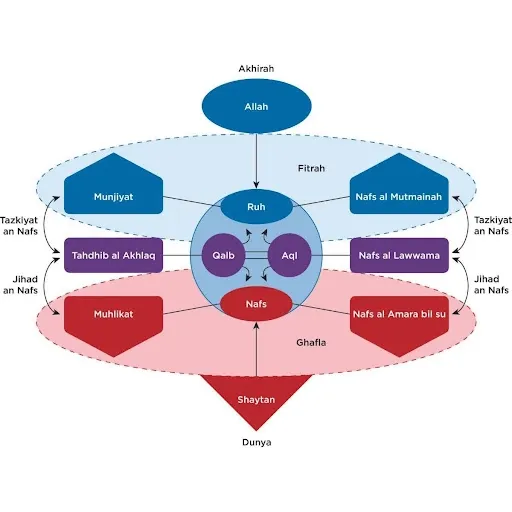
Appreciating a conceptual framework rooted in Islamic principles as a means of understanding being and its interrelationship with health is an essential starting point for any discourse on Islam and healing. There are different components of being. The body and the soul. The body is considered a sacred trust given to the human. There is a duty to care for it and be appreciative stewards of this gift. This is true for the person who has the body, as well as for those who care for it (healthcare workers). The concept of the soul is complex and has been comprehensively discussed by the Cambridge Muslim College. There are four components of the soul that can adequately illuminate how we should view ourselves: Nature, structure, stages and development. The nature of the soul is based on the “fitrah” of natural divine alignment that the soul has been created to be in (i.e., in worship). This nature is polluted by ‘dunya’ (or the world), which distracts the fitrah from its purpose. The stages of the soul include the Qalb (heart), Ruh (spirit), Aql (intellect) and Nafs (the lower self). The Qalb can turn towards the higher soul or to the divine by enacting goodness, or can turn towards the Nafs or lower self by being preoccupied with dunya or turning towards evil. Aql is a way of rationalising the qalb - the way one’s intellect justifies the state they find themselves in. Qalb and Aql are capable of changing. There is potential for good or bad. However, the Ruh is a permanent fixture of the fitrah and is seen as pure and divine. It is a point of entry for spiritual healing. The stages of the soul are described as fluctuating states of the Nafs, or lower self. One can find oneself in different stages of the soul. There is Nafs Al Ammarah (the soul that inclines to evil). This is where hedonism reigns, and evil is easy to come to. It is where the fitrah is distracted, and the Qalb is lost. Nafs al Lawwama is the self-reproaching soul. This is where one resists the pull of evil, nafs, and distraction. They are actively working on self-improvement. The last stage is nafs al mutmainah (the soul at rest). This is described as more of an ideal and something to strive towards. The development of the soul has three components. This is about the processes one goes through to change the soul. Firstly, there is Tazkiyat an nafs (Purification of the Soul). This is about purifying the soul to reach the higher aims of one’s natural fitrah and ruh. There is also Jihad an Nafs (the struggle of the soul). This is the process of struggling against the lower self (Nafs, dunya, etc.) and working towards the higher self. Finally, there is tahdhib al akhlaq (the refinement of character). Essentially, one must refrain from muhlikat (vices). These are natural tendencies in the Nafs, such as greed. The cure for such vices is munjiyat (virtue). So, for example, the mukhlikat of greed would be cured by the munjiyat of fasting. The following diagram illustrates this conceptual framework:
History
Understanding the body and soul in a conceptual framework is useful in the academic sense. However, concrete examples exist in Islamic history which illustrate how this framework was used as a foundational principle for healing. The first hospitals or Bimaristans (house of the sick) in medieval Islamic history employed treatments that were both physical (diet, cupping, ointments, surgery), mental (talk therapies), environmental (open courtyards with fountains), and spiritual (recitation and prayer). It is interesting to note that healing of the body incorporated not only physical health treatments but also mental health treatments. This shows an early understanding that body and mind needs to be equally prioritised for good health. Appreciating the importance of mental health predates modern medicine’s perspective on the topic. Environmental healing, such as courtyards and gardens, was designed in the context of Islamic descriptions of the gardens of paradise. Spiritual healing included recitation and prayer. These treatments fall within the realm of Tazkiyat an-Nafs (purification of the soul). Environmental and spiritual factors healed the soul, where the physicians at the Bimaristan aimed to heal the body and mind. In this way, Islamic holistic care treated patients across the physical, mental, environmental and spiritual dimensions. Each dimension was considered important.
Today
The Muslim community finds itself in a dilemma. Muslim physicians are taught modern medicine and are unable to appreciate the gaps in providing culturally competent care. Muslim patients are accessing a healthcare system that is founded on a praxis of modern medicine that is predominantly based on pharmacological treatment. It neglects the mental, environmental and spiritual components of care that Islamic healing requires. These patients do not find it in the healthcare system they access, nor in the Muslim physicians they hope would be able to bridge the gap. There is an evident conflict of healthcare systems using language such as “inclusive” whilst not understanding the Islamic approach to healing. As this approach is not used in everyday life, the Muslims who access modern healthcare can find the use of the word “inclusive” to be tokenistic. One example of care to illustrate the miscommunication between the healthcare system and the Muslim community is mental health care. There is stigma amongst the Muslim community to access mental health care. This is often due to a perceived ‘shame’. Appreciating that Islamic healing has always valued mental health as important to people’s wellbeing should be used as a way to challenge the current status quo. Whilst from the perspective of the healthcare system, their general approach is to continue with evidence-based psychological interventions such as Cognitive Behavioural Therapy (CBT) without recognising the lived experiences of Muslims. In the modern-day context of Islamophobia, failing to understand the racialised or discriminatory aspects that the community has faced is a futile exercise. The politics of control can be stifling to the idea of soul-healing. It is a descent towards the lower self and is a genuine barrier to seeking help. How can one seek help from a system that doesn’t recognise the validity of one’s soul? The clash between the Muslim community and the healthcare system is something that is worrying when we use language such as ‘culturally competent’ or ‘inclusive’. We need to appreciate the principles of Islamic healing for these words to mean something and for genuine change to occur.
Where does this leave the Muslim patient or physician?
The Muslim community needs to be more open about mental health and reflect upon how Islamic healing treated all spheres of health: spiritual, physical, environmental and mental. Secular healthcare systems need to move towards true inclusive healthcare. This involves understanding that an Islamic conceptualisation of health differs from that of modern medicine (evidence-based treatments that are predominantly pharmacological). Spiritual and environmental healing needs to stand alongside evidence-based medicine. This is the first step towards a more concrete and inclusive Islamic healing. There is a need to reflect on the conceptual framework for the body and soul. As the Bimaristans historically treated patients physically, mentally and spiritually, so must we today. Modern hospitals can treat patients physically, but we need to add elements of healing used historically in Bimaristans for mental, environmental, and spiritual healing. The Muslim physician needs to understand these gaps within the community and the healthcare system. Understanding Islamic concepts on healing and the gaps that exist today is the first step towards bridging them.
Critical discussion points on bridging the gaps to culturally competent Islamic healing in modern medicine:
Open discussions should happen within the Muslim community. There is a need to discuss the body-soul framework. Muslim communities need to tackle stigma and impress that healing occurs physically, mentally, environmentally and spiritually. There can be no neglect of any sphere of healing. Critical and academic discussions must occur amongst Muslim healthcare workers. How do healthcare workers conceptualise the idea that their job is divine stewardship over the body? How do Muslim physicians advocate for treatment based on the framework of the body and soul in everyday life (especially where treatment is dominated by guidelines)? How do Muslim physicians aim to make this treatment recognised as evidence-based?The role of the environment. How can we support hospital wards being redesigned to include more places for natural light or water features? The role of the chaplaincy. There is a need to design a course that highlights the role of the Imam not only as a religious leader but also as a spiritual healer actively involved in a patient’s recovery. How can we advocate for protected prayer times or prayer spaces that are accessible to everyone, wherever they are in a hospital? Can Muslim physicians include a spiritual component in their medical history to elicit needs and refer to the appropriately trained Imam? How can this be developed?How can the role of the family be changed into an empowering tool for healing? The role of the community is important and can encourage recovery through the positive effects of social connection. In modern medicine, the community is controlled for a patient’s rest, or is only seen as needed when there is deterioration. This can be radically changed to achieve a positive impact.
Concluding remarks
The modern healthcare system is currently tokenistic in its inclusivity in providing culturally competent care to Muslims. This has arisen from the dominance of evidence-based medicine focused on pharmacological cures. Appreciating the historical role of Bimaristans as the first hospitals and the value they bring by adhering to Islamic principles is essential. Muslim Physicians have a responsibility to illuminate this framework and advocate for its use in evidence-based treatments. The illumination of this history and framework also has its use in tackling stigma in accessing mental health care within the Muslim community. We conclude with 6 critical discussion points that Muslim healthcare leaders should explore to generate productive ideas and further the development of truly inclusive care for Muslims in modern healthcare systems. We hope that these thoughts can serve as a starting point and a call to action for both Muslim physicians and the Muslim community to work together to bridge the gap with the modern healthcare system, ensuring it is inclusive and accessible for all.
References
https://pubmed.ncbi.nlm.nih.gov/23908718/2)https://www.cambridgemuslimcollege.ac.uk/wp-content/uploads/2020/10/cmc_papers_9_v4.pdf3) https://pmc.ncbi.nlm.nih.gov/articles/PMC7689558/#sec5-13634615209626034) https://www.researchgate.net/profile/Nev-Jones-2/publication/288623548_Mental_health_stigma_in_the_Muslim_community/links/597aa1910f7e9b0469c7804b/Mental-health-stigma-in-the-Muslim-community.pdf?origin=publication_detail&_tp=eyJjb250ZXh0Ijp7ImZpcnN0UGFnZSI6InB1YmxpY2F0aW9uIiwicGFnZSI6InB1YmxpY2F0aW9uRG93bmxvYWQiLCJwcmV2aW91c1BhZ2UiOiJwdWJsaWNhdGlvbiJ9fQ5) https://www.tandfonline.com/doi/full/10.1080/13617672.2024.2320013