RSS Presence in the US: A Concern for the Future?

Ibrahim Safi – The Public Trust
In 2025, the Washington lobbying firm Squire Patton Boggs filed disclosures introducing the Rashtriya Swayamsevak Sangh (RSS) to US officials. Conducted by an Indian American individual named Vivek Sharma [1], its expenditure on foreign policies totaled $330,000. Despite the overwhelming evidence of their association, the RSS denies any relation with the firm. However, such contentions did alert the American public as to who they are.
The RSS was founded in 1925 as a Hindutva organization, Hindutva being a political ideology advocating for Hindu supremacism and nationalism [2]. One of their greatest organizational inspirations was the Nazi Party. One of the RSS’s early leaders, M.S. Golwalkar, praised the methods for maintaining Germanic racial purity in his book, We or Our Nationhood Defined.
Golwalkar wanted to enforce similar policies on the Muslim and Christian minorities of India, either forcefully assimilating them into Hindu culture or exterminating them as subordinate entities [3]. Unlike religions like Islam and Christianity, which are primarily evangelical and define belonging by belief rather than birth, Hinduism fundamentally works as an ethno-cultural religion. One’s birth determines their caste and ability to worship [3].
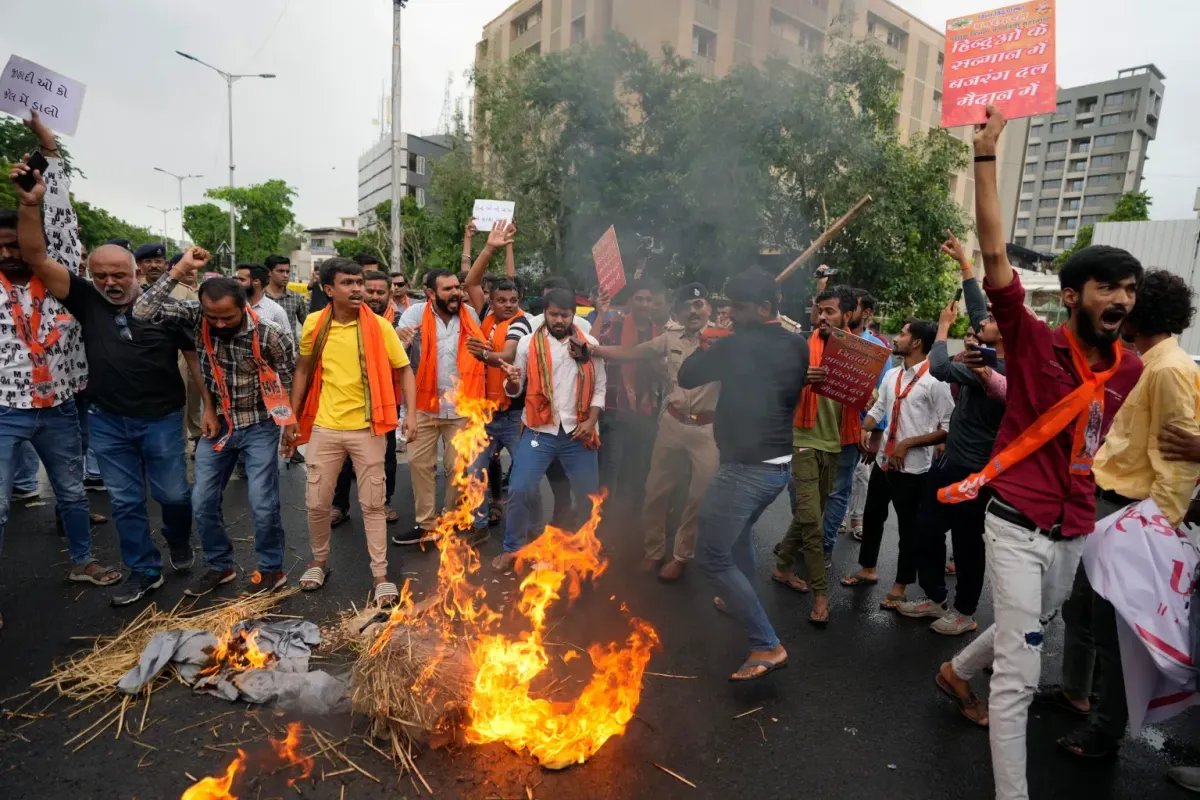
Early Hindutva thinkers saw the evangelizing and social equity of Islam and Christianity as a fundamental threat to Hinduism, especially after many low-caste Hindus began converting to them [3]. So, the RSS’s early thinkers proposed an alternative Hindu Rashtra (Hindu nation) where India was an exclusive Hindu state— for the Hindus, by the Hindus [4]. The legacy of such was many atrocities, such as the demolition of the Babri Masjid (A historic mosque in the city of Ayodhya) in 1992 by Hindu nationalists claiming that a Hindu temple was beneath the structure. In 2002, there was the Gujarat Genocide, a massacre killing over 2,000 muslims and displacing 150,000 more. However, non-governmental organizations estimate higher numbers [5]. Many historians have since disproved this [6]. Indeed, many of these crimes do continue to this day as Hindutva mobs regularly engage in cow vigilantism, scouring voter registration lists and targeting Muslim homes and businesses under claims of beef consumption and storage. In all these cases, the RSS was either the instigating or directly participating party, with their perpetrators often going unpunished [7].
For periods in the 20th and 21st centuries, due to the RSS’s association with politically and religiously inspired terrorism, it was frequently banned by the Indian government. The first ban was after the assassination of Mahatma Gandhi, known as the father of the nation in India due to his pivotal role in national independence, conducted by RSS member Nathuram Godse [4]. It was repealed a year later after the RSS pledged loyalty to the Indian constitution. In 1975, during India’s national emergency, the RSS was banned again as a result of various terrorist attacks and public order disruption. However, the ban was repealed after an opposition party came to power [4]. Finally, in 1992, after the Babri masjid demolition and the various array of massacres that followed, the prime minister, Narasimha Rao, imposed the last ban on grounds of terrorism. The Liberhan Commission repealed it a year later, arguing that the group was not directly involved in terror activities [4].
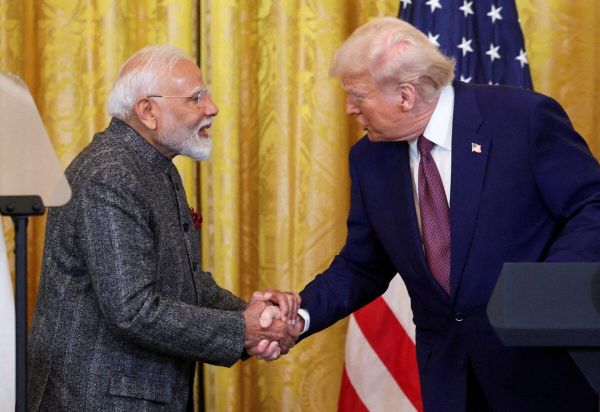
Consequently, the RSS realized that their strategy for influencing Indian politics would need to change. Consequentially, the Bharatiya Janata Party (BJP) was founded, mostly by RSS members: officially a conservative political party, unofficially the political wing of the RSS [7]. Now the RSS (via the BJP) contests in elections rather than stirring up mob riots and is the current ruling party of India. The BJP’s leader and India’s incumbent Prime Minister, Narendra Modi, was an RSS member for the majority of his life [6]. In fact, as a result of the Gujarat Massacres and Genocide, Modi’s visa to the US was banned until 2014.
Upon being elected prime minister, it was lifted by President Obama for a visit to Washington, DC. The RSS also began receiving far less scrutiny after Modi’s election, and the previously mentioned increase in riots against Muslims, usually instigated by the RSS, went unpunished by the Indian government [4]. Currently, for a majority of Hindu voters, the BJP is a popular party regardless of the many pogroms regularly carried out against Muslim, Christian, Dalit, and Sikh groups [6].
The story of the politics conducted by the RSS then translates to American contexts, especially beginning in the 1960s, but especially from the 1990s onwards, an increasing population of Indian Americans began immigrating to the United States, the majority of them being Hindu. As a diasporic minority, many began forming communal organizations closely associated with those back in India. So, when the RSS and BJP began to gain popularity, they also did so within the Indian diaspora in the US, with the founding of the Hindu Swayamsevak Sangh (HSS) [8].
The HSS acknowledges on its website that it’s ideologically inspired by the RSS, and many believe that the HSS is a subsidiary of the RSS. However, this cannot be admitted, as such activity is illegal under the US Constitution. On the surface, the HSS presents itself as a cultural organization instilling Hindu values and religion in its youth. But over the past decade, they have increased political lobbying, especially for pro-RSS and pro-BJP policies. The HSS raises funds for the RSS projects in India, a key example being the desecration of the Babri Masjid and construction of the Ram Temple upon its ruins [8].
The RSS has been banned for terror-inspiring activities in India multiple times, and is currently instigating genocides in Assam and Kashmir, which are labeled as stage 6-8 (between polarization, preparation, and persecution) by Genocide Watch, with stage 9 being active genocide [9]. The RSS claimed inspiration from the Nazi party, conducted Gandhi’s assassination, and massacred numbers of Muslim, Christian, Sikh, and Dalit populations across India [3]. The RSS is actively setting up a cadet branch in the US via the HSS and receives millions, if not billions, of dollars in donations from Hindu-American communities sympathetic towards their political goals in India, with the majority of Hindu-Americans being pro-BJP and many more joining the HSS [10].
As Americans, we must ask ourselves whether we are willing to accept such a group lobbying our government. 20 years ago, our government saw the RSS and its affiliated groups as vile enough to ban one of its premier members from even entering our country. Today, the government appears to be courting them.
Sources
1. Squire Patton Boggs. “Lobbying Report: State Street Strategies d/b/a One+ Strategies OBO Rashtriya Swayamsevak Sangh.” Lobbying Disclosure Act Database, United States Senate, 2025. https://lda.senate.gov/filings/public/filing/86f3ac26-5585-49b8-8573-cdf00e5f0a95/print/. Accessed 18 Aug. 2026. 2. Carnegie Endowment for International Peace. “How Do Indian Americans View India? Results from the 2020 Indian American Attitudes Survey.” Carnegie Endowment for International Peace, 9 Feb. 2021.https://carnegieendowment.org/research/2021/02/how-do-indian-americans-view-india-results-from-the-2020-indian-american-attitudes-survey. Accessed 18 Aug. 2026. 3. Golwalkar, M. S. We, or Our Nationhood Defined. Bharat Publications, 1939. 4. Casolari, Marzia. In the Shadow of the Swastika: The Relationships Between Indian Radical Nationalism, Italian Fascism and Nazism. Routledge, 2020. 5. “Fascism in India: Race, Caste, and Hindutva.” Perspectives on Politics, Cambridge University Press, 2026.https://www.cambridge.org/core/journals/perspectives-on-politics/article/fascism-in-india-race-caste-and-hindutva-fascism-in-india-race-caste-and-hindutva-by-luna-sabastian-cambridge-ma-harvard-university-press-2025-285p/C2E41B82C601FB68C8D43B3764648DEC. Accessed 18 Aug. 2026. 6. Human Rights Watch. Politics by Other Means: Attacks Against Christians in India. Human Rights Watch, 1 Oct. 1999. https://www.hrw.org/report/1999/10/01/politics-other-means-attacks-against-christians-india. Accessed 18 Aug. 2026. 7. Human Rights Watch. Compounding Injustice: The Government’s Failure to Redress Massacres in Gujarat. Human Rights Watch, 30 June 2003. https://www.hrw.org/report/2003/06/30/compounding-injustice/governments-failure-redress-massacres-gujarat. Accessed 18 Aug. 2026. 8. Jaffrelot, Christophe, and Ingrid Therwath. “The Sangh Parivar and the Hindu Diaspora in the West: What Kind of ‘Long-Distance Nationalism’?” International Political Sociology, vol. 1, no. 3, 2007, pp. 278–295. 9. Genocide Watch. “Genocide Warning: India.” Genocide Watch, 24 Dec. 2020, https://www.genocidewatch.com/single-post/genocide-warning-india. Accessed 18 Aug. 2026. 10. Jaffrelot, Christophe. The Hindu Nationalist Movement and Indian Politics: 1925 to the 1990s. Columbia UP, 1996. https://books.google.com/books/about/The_Hindu_Nationalist_Movement_in_India.html?id=Y2buDDwdgIsC. Accessed 18 Aug. 2026. 11. Human Rights Watch. “We Have No Orders to Save You”: State Participation and Complicity in Communal Violence in Gujarat. Human Rights Watch, 30 Apr. 2002.https://www.hrw.org/report/2002/04/30/we-have-no-orders-save-you/state-participation-and-complicity-communal-violence. Accessed 18 Aug. 2026. 12. United States Department of Justice. Report of the Attorney General to the Congress of the United States on the Administration of the Foreign Agents Registration Act. U.S. Department of Justice.https://www.justice.gov/nsd/media/1289586/dl?inline=. Accessed 18 Aug. 2026. 13. Therwath, Ingrid. “Cyber-Hindutva: Hindu Nationalism, the Diaspora and the Web.” Social Science Information, vol. 51, no. 4, 2012, pp. 551–577.