Morocco-US-Israel vs. Spain

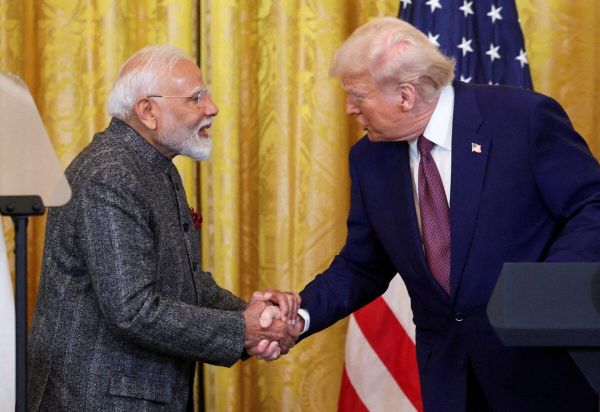
In late 2020, Morocco signed the Abraham Accords alongside Bahrain, the UAE, and Sudan, seeking to normalize Arab nations’ diplomatic ties with Israel [1]. Israel's long-standing ally, the United States, also took part in this so-called peace treaty [1].
Though the agreement's intentions were for Israel to ease relations with Palestine, Israel and the US manipulated the conditions based on the weaknesses of the Arab nations involved [1]. Israel did not agree to a two-state solution with Palestine, but Moroccan officials still signed the Accords on the basis that the US would recognize the disputed territory between them and Western Sahara as Moroccan [2].
Since then, Israeli-Moroccan ties have only strengthened. Moroccan Jews can easily travel between Marrakesh and Tel Aviv, and Morocco has been one of Israel's largest defense purchasers since 2021 [2,3]. In a way, their stances on the disputed West Bank and Western Sahara are a direct connector for the two nations.
On the other hand, Spain’s Prime Minister, Pedro Sanchez, has garnered international attention for his progressive and socialist policies in an increasingly conservative Europe [4]. One of Sanchez's most significant political moves was the formal recognition of Palestine as a state in 2024 [4]. Following October 2023 and Israel’s overwhelmingly torturous response towards Palestinians, Pedro Sanchez has continuously expressed his disdain for Israel and the US. Earlier this year, he denied Donald Trump's request to use Spanish military bases for their attacks against Iran [5].
The 54-year-old PM now positions Spanish politics both ideologically and definitively against the US-Israeli military regime [4]. Domestically, Sanchez welcomes immigrants, both documented and undocumented, on the basis of fostering a thriving and diverse Spanish economy [4]. In contrast, the American Immigration and Customs Enforcement (ICE) agency has detained 65,765 people in the United States as of July 2026 under the Trump administration [6]. With both administrations so greatly opposing the other, Spain’s recent border crisis with Morocco calls for speculation.
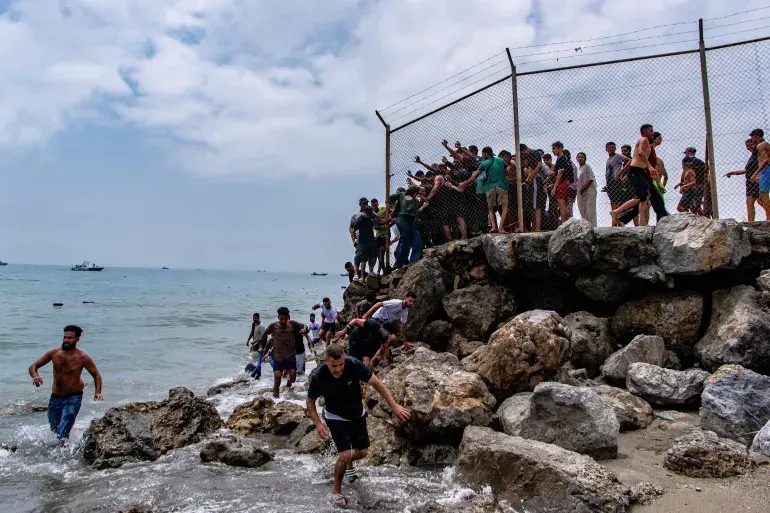
In 2021, over six thousand Moroccans stormed their border with Spain in an effort to illegally enter the Spanish territories of Ceuta and Melilla [7]. In response, the Spanish government blamed Moroccan officials for allowing such an event to happen as a means of pressure against Spain for denying the Moroccan right to claim Western Sahara [5]. Fast forward to July 30, 2026, when over eighty thousand Moroccans attempted to cross, leaving at least 57 dead [8].
This time around, the Moroccan government "encouraging" illegal immigration to Spain holds much greater implications than simply a border dispute. Almost six years into signing the Abraham Accords, Morocco is only short of the UAE as Israel and the US's strongest Arab ally [3]. With Sanchez's increasing pro-Palestinian and pro-Iranian rhetoric, many are led to believe that the US and Israel played a role in the Moroccan border storming [5,9]. The Ceuta crisis invokes further conversation when the geography of the territory is considered [7].
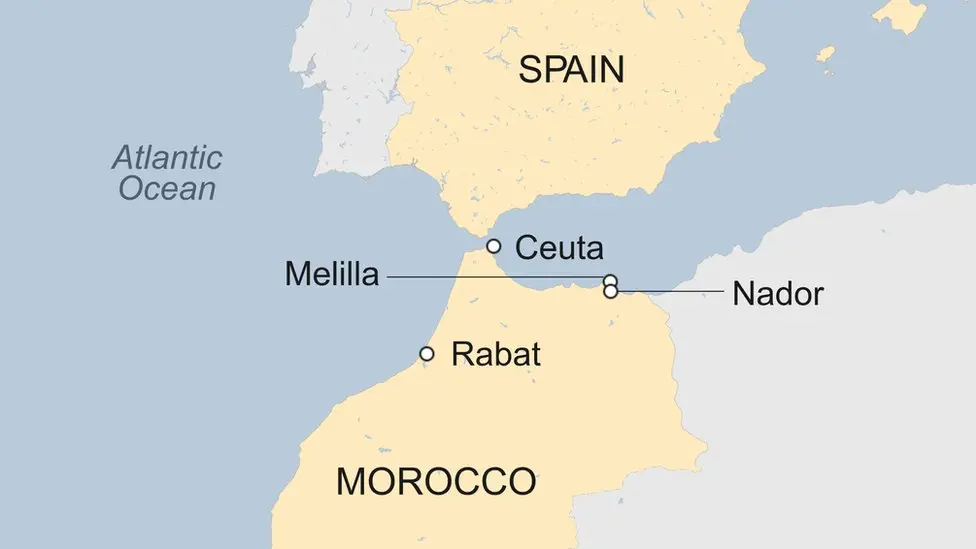
Though they are legally Spanish, Ceuta and Melilla are both situated on the Moroccan mainland rather than the Iberian Peninsula, creating an avenue for American and Israeli politicians to accuse Spain of hypocrisy [5,7,9]. Both Tel Aviv and Washington mock Sanchez's governance post-July 30, arguing that such liberalist immigration policies lead to chaos such as in Ceuta [5]. Vice President J.D. Vance stated on July 31st that what happened in Ceuta is "consequences of mass migration and the radical left-wing globalist policies that have enabled the Invasion of the West" [5].
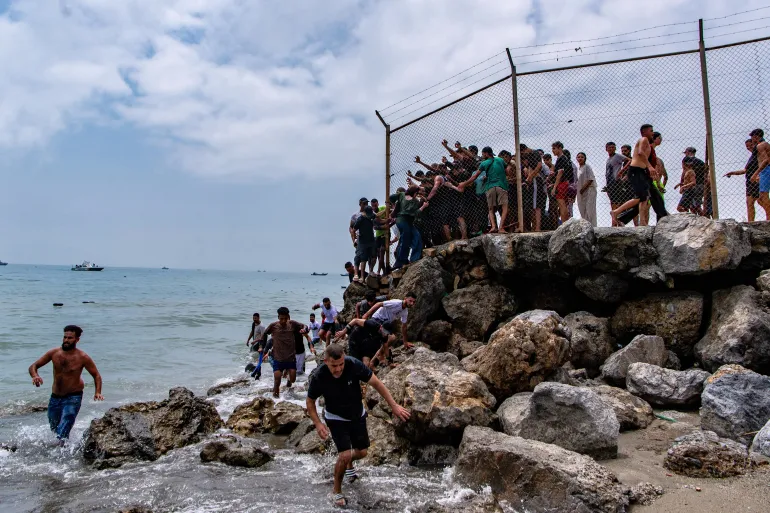
The Moroccan government denied any involvement in the event, blaming misinformation spread through social media coupled with human trafficking [5]. However, the scale of the crowd, the US and Israel's immediate and powerful rhetoric against Sanchez, as well as the three-way alliance that deepened among the three countries in the past six years, suggests that the eighty thousand Moroccans did not just happen to approach the Spanish border on July 30th.
As of August 10, only eight to ten thousand (10-12%) of those who stormed the border remain in Ceuta [8]. Thus, it begs the question: was this a spontaneous migration or a calculated message?
Though the answer may never be definitively known, the consequences are clear. Spain, a major European power and NATO member, is rattled [4,5]. Prime Minister Sanchez, one of, if not, Europe's most vocal critics of Israel and America, is politically wounded [4,5,9]. Conversely, Morocco, Israel, and the United States demonstrate the power of their new axis, one that uses human desperation as currency and borders as weapons [3,5].
Sources
1. Middle East Institute, "The Abraham Accords: A Backgrounder," Middle East Institute, 2020, https://mei.edu/backgrounder/abraham-accords/. 2. Dr. Mohamed Chtatou, "Understanding Moroccan 'Normalization' with Israel," The Washington Institute for Near East Policy, January 5, 2021, https://www.washingtoninstitute.org/policy-analysis/understanding-moroccan-normalization-israel. 3. Sarah Leah Whitson, "Are US and Israel benefitting from 'migration blackmail' in Spain?," Responsible Statecraft, August 5, 2026, https://responsiblestatecraft.org/morocco-spain-migrants-israel/. 4. Scott Spires, "Pedro Sánchez," Encyclopedia Britannica, April 28, 2026, https://www.britannica.com/biography/Pedro-Sanchez-politician. 5. Sarah Leah Whitson, "Are US and Israel benefitting from 'migration blackmail' in Spain?," Responsible Statecraft, August 5, 2026, https://responsiblestatecraft.org/morocco-spain-migrants-israel/. 6. TRAC Reports, "ICE Detention Quick Facts," TRACReports.org, July 11, 2026, https://tracreports.org/immigration/quickfacts/. 7. BBC News, "Ceuta, Melilla Profile," BBC News, May 18, 2023, https://www.bbc.com/news/world-africa-14114627. 8. Anadolu Agency, "Spain raises estimate of migrants who entered Ceuta to 80,000 as city struggles with aftermath," Anadolu Agency, August 2026, https://mobil.aa.com.tr/en/europe/spain-raises-estimate-of-migrants-who-entered-ceuta-to-80-000-as-city-struggles-with-aftermath/4023300. 9. Al Jazeera, "Is Spain being punished?," Al Jazeera, August 1, 2026, https://www.aljazeera.com/opinions/2026/8/1/is-spain-being-punished.