Faith, Power, and the Iran War

James Steinmetz – The Public Trust
On February 28, 2026, the United States joined Israel in launching Operation Epic Fury against Iran [2]. The decision immediately put one of Donald Trump’s most prominent political claims to the test: that he opposed the costly, prolonged wars that had defined much of the post-9/11 era. During his 2016 campaign and again in 2024, Trump repeatedly criticized the Iraq War and positioned himself against foreign policy decision-makers whom he accused of sending Americans into conflicts with no clear end [3]. The Iran war may have stemmed from legitimate security concerns, but the administration’s rhetoric, especially Pete Hegseth’s militarized religious language, risks framing a strategic conflict as a moral and existential battle. This approach clashes with the antiwar identity Trump has cultivated and risks undermining the constitutional principles meant to place limits on American power.
The administration maintains that Iran’s nuclear program, missile capabilities, support for armed groups, and threats toward Israel and U.S. interests justified military action [4]. Those concerns are legitimate and warrant serious consideration. Yet, when a campaign moves beyond deterring Iran to destroying its missiles, navy, security apparatus, and capacity to develop a nuclear weapon [4], when does it become another open-ended war? Also, what happens to a political movement that repeatedly campaigned against “forever wars” when it ultimately launches one?
The administration has defended the war as necessary and stated that the United States is not starting a new war but responding to a conflict Iran has waged against America and its allies since the 1979 revolution [5]. Iran’s record of hostility toward the United States, support for regional armed groups, development of missiles, pursuit of a nuclear program, and the capacity to develop a weapon are legitimate concerns [4]. At the same time, the broader history of U.S.-Iranian escalation cannot be ignored, including the CIA and British-backed 1953 coup against Prime Minister Mohammad Mossadegh, decades of sanctions and military pressure, and Trump’s 2018 withdrawal from the nuclear agreement [6,7]. The question is not whether Iran presents serious challenges but whether those challenges justify expanding the war, whether such action is proportionate, and whether it’s likely to make the Middle East safer. Calling military action “preemptive” or “defensive” does not resolve those questions. It can make escalation seem unavoidable rather than be a deliberate political choice.
American wars are usually publicly defended for the purpose of national security, democracy, freedom, or the defense of allies. Iran’s nuclear program is central to the administration’s case, especially because the 2015 Joint Comprehensive Plan of Action (JCPOA), commonly referred to as the Iran nuclear deal, placed verifiable restrictions on Iranian nuclear activity in exchange for sanctions relief [8]. Trump withdrew the United States from the agreement in 2018 [6]. Whether or not the administration’s strategic justification is convincing is something Americans should continue to debate. What happens though when those strategic arguments are framed in religious terms that portray the conflict as a battle between virtue and fanaticism? Religious rhetoric becomes dangerous when it converts these contestable political goals into sacred obligations beyond debate.
From Deterrence to Sacred Conflict
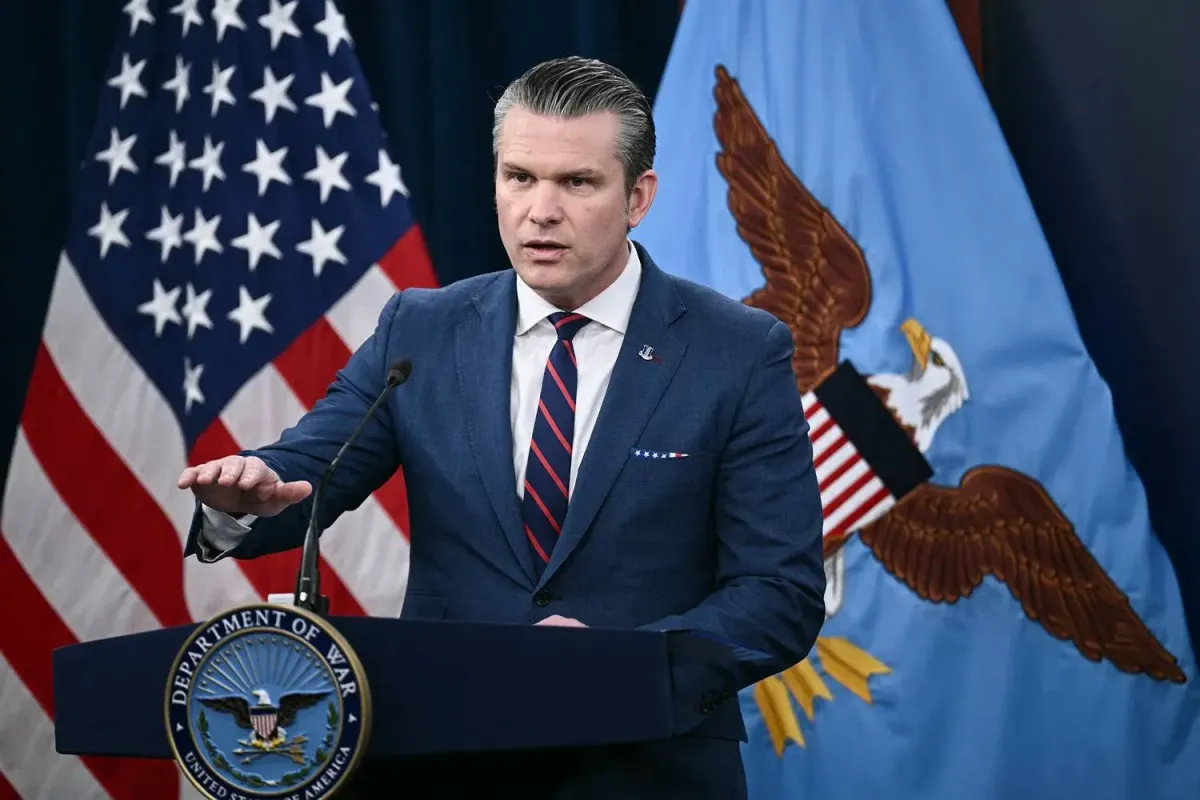
What keeps bothering me is not just the argument for the war but the language used to sell it. Hegseth has called Iran’s clerical leaders “religious fanatics” pursuing nuclear capability for “religious Armageddon” [9]. If that’s how he understands Iran, it’s fair to ask what he thinks happens when an American defense secretary brings his own religious language into a war.
Iran is an Islamic republic whose political system gives Twelver Shi’a clerics exceptional formal authority [10]. Yet, the fact that Iran’s government uses religious ideology does not, by itself, justify an open-ended war. It becomes especially troubling when an American defense secretary condemns an enemy’s religious absolutism while invoking Christian language that can cast U.S. military violence as righteous [9]. It becomes even more pressing when the administration’s strategic case is expressed through religious language, particularly by Defense Secretary Pete Hegseth.
I’m not arguing that Hegseth began this war because of his religious beliefs. My concern is that his language gives the war a religious storyline: America as righteous, Iran as fanatical, and military force as something blessed rather than merely chosen. Describing himself as “a man of faith” and invoking “the providence of our Almighty God” over American troops, Hegseth has made Christian prayer and scriptural language a visible part of his leadership at the Pentagon during the Iran war [9]. This included a worship service where he recited a prayer for “overwhelming violence of action against those who deserve no mercy,” ending “in the mighty and powerful name of Jesus Christ” [11].
This isn’t an inference pulled from nowhere. At a Pentagon briefing during the Iran war, Hegseth recited Psalm 144, a passage about God training hands for war [9]. Years earlier, in his book American Crusade, he called for “a holy war for the righteous cause of human freedom” [12]. I don’t think public officials need to hide their faith, but it matters when religious language is used to fuel the machinery of war.
There’s an obvious difference between Iran and the United States, and it shouldn’t be brushed aside. Iran is a formal Islamic republic where Shiite clerical authority is built into the state [10]. America is not that. But the fact that the countries are different does not mean Americans should ignore their own institutions when government officials make one religious vision feel superior to everyone else’s.
This would be a different matter if Hegseth were only speaking as a television commentator or author. But he is the defense secretary, and his words carry the authority of the Pentagon, an institution that represents Americans of every faith, as well as those who have none [13]. He has hosted Christian worship services there, including one featuring conservative pastor Doug Wilson [14]. There’s nothing inherently wrong with an official praying. However, what if religious messaging from government officials could make some service members and citizens feel that their faith, or lack of faith, places them outside the vision of America being presented?
Hegseth doesn’t need to be an “end times” literalist for his faith to shape his politics. The issue isn’t that he believes in God. It’s that he describes the religious language of an adversary as fanaticism while speaking about American power in terms of righteousness, national defense, and civilization. That’s a double standard [9].
The religious rhetoric of this administration is certainly not the sole cause of the war. It should not be front and center of the geopolitical debate over the conflict, but religious commitments and rhetoric can shape how officials frame the conflict, its enemies, and the use of force. More importantly, it risks weakening U.S. legitimacy by making the conflict appear to be a contest between rival religious visions rather than a policy choice subject to democratic scrutiny. You could call it an intentional flaw in the way the United States is structured, but even if someone isn’t elected, they have a responsibility to represent the people of their country while in charge of the institution they’re entrusted with.
The Constitutional Balance
It’s not a good idea to personally attack someone’s faith. This is just to point out a specific way that our defense secretary is using his. Christianity has inspired many abolitionists and civil rights advocates, even as other Christians and institutions used religious arguments to defend slavery and segregation. When public officials blur the line between personal faith and the authority of the state, they risk departing from the constitutional balance those provisions are meant to protect. Article VI prohibits religious tests for federal office, while the First Amendment both protects the free exercise of religion and prohibits laws respecting an establishment of religion [15]. This is an intentional balance by the Founding Fathers [16]. We've never been perfect, and that’s why those willing to stand on principles are always valued.
The answer is not to chase religion out of public life, but it’s also not to turn the government into a vehicle for one religious worldview. Public power should answer to the Constitution, evidence, and democratic consent of people of every faith and of no faith.
I think America is best when we allow for freedom of thought and expression while preventing individuals from feeling marginalized and keeping society safe. Anyone practicing their faith is completely fine, but it becomes a problem when a high-level official invokes divine protection and biblical war imagery while directing an active military campaign. It becomes dangerous when someone treats others as if they cannot disagree with them. As it is today, Congress has lost hope in itself regarding where it can exert its power. As everyday citizens, it’s our job to direct our attention to what truly deserves it.
Sources:
1. John Haltiwanger, “Pentagon Says Iran War Is ‘Not Iraq,’ but Won’t Rule Out Boots on the Ground,” Foreign Policy, March 2, 2026, https://foreignpolicy.com/2026/03/02/pentagon-briefing-iran-hegseth-iraq-boots-on-ground-trump/. 2. “Operation Epic Fury” Eclipses Diplomacy,” The Soufan Center, February 28, 2026, https://thesoufancenter.org/intelbrief-2026-february-28/. 3. Scott Detrow, “Trump promised the MAGA base no new wars. Then he went to war with Iran,” National Public Radio, March 3, 2026, https://www.npr.org/transcripts/nx-s1-5733999 4. Reed D. Rubinstein, “Operation Epic Fury and International Law,” U.S. Department of State, April 21, 2026, https://www.state.gov/releases/office-of-the-legal-adviser/2026/04/operation-epic-fury-and-international-law. 5. “Secretary of War Pete Hegseth and Chairman of the Joint Chiefs of Staff Gen. Dan Caine Hold a Press Briefing,” U.S. Department of War, March 2, 2026, https://www.war.gov/News/Transcripts/Transcript/Article/4418959/secretary-of-war-pete-hegseth-and-chairman-of-the-joint-chiefs-of-staff-gen-dan/. 6. Kevin Breuninger, “Inside the Obama-era Iran nuclear deal that Trump withdrew from,” Consumer News and Business Channel, June 8, 2026, https://www.cnbc.com/2026/06/06/trump-iran-jcpoa-nuclear-deal-obama.html. 7. Gregory F. Treverton, “CIA agents successfully executed a plan for regime change in Iran in 1953 – but Trump hasn’t revealed any signs of a plan,” University of Southern California Dornsife, March 3, 2026, https://dornsife.usc.edu/news/stories/cia-agents-successfully-executed-regime-change-plan-in-1953-iran-but-trump-hasnt-revealed-signs-of-a-plan/. 8. “Iran's nuclear agreement,” Council of the European Union, September 29, 2025, https://www.consilium.europa.eu/en/policies/jcpoa-iran-restrictive-measures/. 9. Tiffany Stanley, “Pete Hegseth's Christian rhetoric reignites scrutiny after the U.S. goes to war with Iran,” Public Broadcasting Service, March 20, 2026, https://www.pbs.org/newshour/politics/pete-hegseths-christian-rhetoric-reignites-scrutiny-after-the-u-s-goes-to-war-with-iran. 10. Eric Lob, “Iran’s ruling structure explained,” Florida International University, March 13, 2026, https://news.fiu.edu/2026/irans-ruling-structureexplained. 11. Tiffany Stanley, “WATCH: At Pentagon Christian service, Hegseth prays for violence 'against those who deserve no mercy',” Public Broadcasting Service, March 26, 2026, https://www.pbs.org/newshour/politics/at-pentagon-christian-service-hegseth-prays-for-violence-against-those-who-deserve-no-mercy. 12. “Pete Hegseth's American crusade,” National Public Radio, June 5, 2026, https://www.npr.org/transcripts/nx-s1-5845047. 13. Tiffany Stanley, “Defense Department slashes its religious designations list from more than 200 choices to 31,” Associated Press, June 5, 2026, https://apnews.com/article/us-military-religious-affiliations-pete-hegseth-christian-002a610344189f4f456291d76b910d52. 14. Haley Britzky, Kaanita Iyer, “Hegseth invited pastor who calls for Christian theocracy to lead Pentagon prayer service,” Cable News Network, February 20, 2026, https://www.cnn.com/2026/02/19/politics/douglas-wilson-pastor-pentagon-service-christian-nationalism. 15. “The Constitution of the United States: A Transcription,” National Archives, https://www.archives.gov/founding-docs/constitution-transcript. 16. “Religion and the Constitution,” Cornell Law School Legal Information Institute, October 2025, https://www.law.cornell.edu/wex/religion_and_the_constitution